
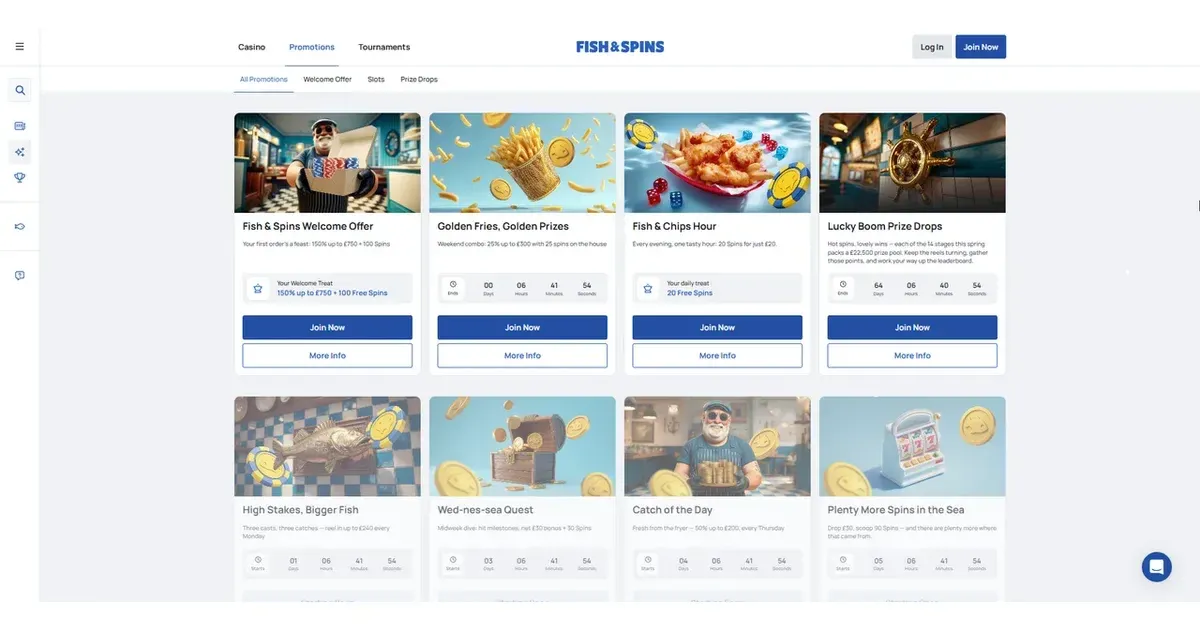
The Fish and Spins official site is the address the operator itself confirms: reached by typing it into the bar or through a bookmark saved the last time you were there, never through a link that arrived in a message. This page is an independent guide to Fish and Spins, not the operator's own site, and it holds no accounts and takes no payments. What follows is how to confirm an address before you enter a password or a card number, how the name is spelt, and the marks that separate the real site from a copy of it.
Where is the real Fish and Spins site?
An address is worth having only once it has been confirmed at source, and that confirmation happens on the operator's own pages rather than in a search result. On the genuine site the cashier sits inside the same pages as the games, the welcome offer on display matches the one written into the terms, and support runs by email and by live chat that stays open 24/7.
Nothing here is an address to copy into the bar. A support e-mail, a screenshot of a cashier, a listing on an app store or a link from an affiliate page each show only that somebody has a page about the brand; none of them shows that the page belongs to it. The test is dull and it works: type the name, read what comes back a character at a time, and save it as a bookmark once you are sure.
What one habit keeps you on the right address?
One route in, and it is a route you made yourself. Type the address or open the bookmark you saved when you last checked it; a link in a text message, a sponsored result at the top of a search, a direct message, a QR code on a flyer and a pop-up on a streaming page are all routes somebody else made, and any of them can lead to a page that copies the layout down to the fonts.
The padlock is not the reassurance it feels like. It confirms that the connection is encrypted to whoever owns the page you reached, and says nothing about who that is; a copied login page can hold a valid certificate and still collect everything typed into it.
How do people spell Fish and Spins?
The name is a phrase as well as a brand, which is why it collects misspellings. Six forms turn up often enough to be worth recognising.
| Spelling | What it is |
|---|---|
| Fish and Spins | the name as the operator writes it: two words, "and" spelled out, both words ending in s |
| Fishandspins | the same name run together as one word |
| Fish & Spins | an ampersand standing in for "and" |
| Fish n Spins | the "and" shortened to a single letter |
| Fish and Spin | the final s dropped from the second word |
| Fish and Spinns | an extra n inside "Spins" |
Only the first row is the name. That matters beyond tidiness, because search engines and phone keyboards quietly correct the others, and a corrected suggestion that looks close is one of the ways a wrong address reaches the top of a list. A misspelling by itself is not evidence that anything exists at that spelling, and this page does not treat it as one.
Type the name as two words with "and" spelled out in full, then compare what the bar shows against those two words before signing in or paying. An address that has gained a word, a hyphen or a different ending is not the one you meant to reach, whatever the page in front of you looks like.
How does a copy give itself away?
Copies rarely fail on one detail; they fail on several at once, and the tells add up.
- An address that differs from the real one by a letter, a hyphen, an extra word or a different ending.
- An offer that beats the one set out on the operator's own terms page by a distance, or a promise that the bonus carries no wagering at all.
- Company and licence details that do not match the ones printed on those same terms, or terms that run to a few lines.
- Support that exists only inside a messenger app, with no email route and no live chat.
- A request for card details, a wallet recovery phrase or a one-time code anywhere outside the cashier.
- An app offered as a file to install from a link, rather than through the store your device already uses.
- Countdown timers and messages urging a deposit within the next few minutes.
Two of those deserve a second look, because pressure hides them. The offer is the easy thing to fake, since a page that never intends to pay can promise anything, while the wall of conditions around a real bonus is what makes it expensive to copy. Credentials are the other: Fish and Spins support works by email and by live chat, and no support desk needs your password or an authenticator code to look at an account.
What does the welcome offer tell you?
Fish and Spins publishes one headline welcome offer: a 150% first-deposit match up to £750, with 100 free spins alongside it. T&Cs apply. 18+. New customers only. Please gamble responsibly (BeGambleAware.org).
The conditions are what make the offer usable as a test. Bonus funds and whatever the spins return carry a 40× wagering requirement unless a promotion states otherwise, and the largest stake allowed while that is running is £5, bonus rounds and doubled bets included.
The ceiling matters as much as the headline: cashout from the welcome offer is capped at £5,000, and a player depositing in cryptocurrency is capped at twice the deposit instead. The 100 spins expire after 3 days and what they win stays for 7, while a cash bonus runs for 10; slots count in full towards wagering, roulette at 25%, card games at 10%, and everything else not at all.
An offer that overshoots that package by a long way, or one that advertises no wagering whatsoever, is the first warning sign worth acting on. The headline is the cheapest part of a page to inflate and the first part a reader checks.
What should you check before you type anything?
Eight checks, most of them a few seconds each, cover the ground that matters.
- Read the address bar a character at a time and confirm the spelling matches the table above.
- Check for the padlock and an address beginning https, then remind yourself that neither proves who owns the page.
- Open the terms and find the company and the licence behind the site.
- Where a regulator is named, search that regulator's public register for the operator before any deposit.
- Hold the offer on screen against the 150% match up to £750 and 100 free spins, cap and expiry included.
- Look at the payment list: cards and cryptocurrency, with a £20 minimum on fiat deposits.
- Try support before you need it – email and live chat, open 24/7, and no request for a password or a code.
- Bookmark the address, then close the tab you arrived on.
A genuine page passes all eight without strain. Where two or three fail together, leave: no offer is worth a card number typed into the wrong cashier, and the smallest deposit Fish and Spins accepts is £20, which is also the smallest withdrawal it processes.
What can you do if you have already entered your details?
Move quickly, and in this order. Change the password on that account and on every other site where the same one was used, then contact the bank or card issuer, ask for the card to be stopped and the payment to be disputed, and note the reference they give you.
Tell Fish and Spins support what happened, writing from the operator's own pages by email or live chat rather than through anything in the message that led you there. Keep the screenshots, the address, the times and the wording of whatever arrived, because a bank dispute and a support case both move faster with them attached.
None of that guarantees the money comes back, and no page can promise it does. What the sequence buys is time, while the details are fresh and the payment has not yet settled – the only thing still in your hands once they have been typed.
18+ only. Gambling is entertainment, not a way out of a money problem, and it stops being either when it stops being a choice. Free, confidential help is available from BeGambleAware.org, from GamCare on 0808 8020 133, and from GamStop for anyone who wants to stop altogether; where a device in your home is shared with someone under 18, parental controls such as Net Nanny or Qustodio close that door.